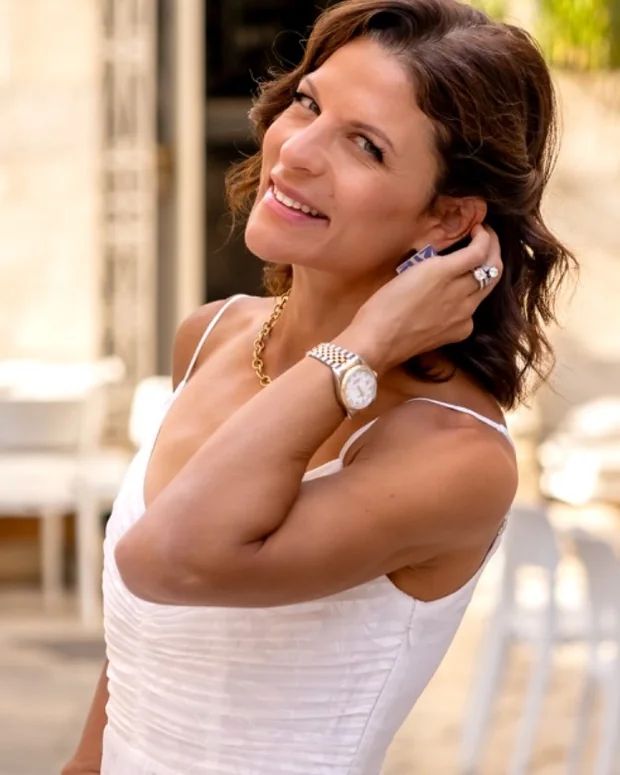
I built this because nobody else had.
I'm a triple board certified physician — neonatology, obesity medicine, lifestyle medicine — and a certified master coach. But what makes the work matter isn't the credentials. It's that I was the woman the system was failing, and I didn't see it until I was already in it.
I hired a night nurse for my husband.
I was a full-time neonatologist, eight weeks postpartum with my second child, getting ready to go back to the hospital. I wasn't sleeping. I knew I wasn't sleeping. And I made sure — every night — that there was a night nurse so that Mark could sleep.
I didn't hire one for myself. It didn't even occur to me to.
That's how deep it ran. I was a physician. I knew what sleep deprivation did to the body. I was caring for the most fragile humans on earth at 3 AM after caring for my own newborn at midnight. And somewhere underneath all of that training, I had absorbed the same belief every woman around me had absorbed: my job is to make sure everyone else is okay first.
It would be years before I could name what I was watching happen — to my patients' mothers, to my colleagues, to myself. But that night nurse decision is the moment I came back to over and over again once I finally understood what I was looking at. The bias was so old, so deep, so quiet, that even a triple board certified physician trained specifically in family systems couldn't see it in her own home.
If it could happen to me, it was happening everywhere.
My clients kept getting more frustrated, not less.
When I started coaching women full-time, I expected what every coach expects — that as they got more tools, more language, more regulation, things would get easier for them. And in some ways they did. They knew themselves better. They were calmer. They were making different choices.
But over and over, the same thing happened: they got more frustrated, not less.
Because they were growing — and the people around them weren't. The husband stayed exactly where he was. The kids stayed exactly where they were. The mother-in-law, the boss, the co-parent. She kept reading the books and doing the work and becoming more capable, and the gap between her and her household kept widening. The more she knew, the heavier the container got. The tools weren't relieving her — they were isolating her.
Three years ago, I started building it. It would have been easier to refer my clients somewhere. But the program I needed to refer them to didn't exist — not from a physician, not built on actual neuroscience, not designed around the woman as the regulated anchor rather than the broken one. So Mark and I built it. He's a board certified child psychiatrist. We built it together because the work needed both.
That became the ARCC framework. That became The FIT Collective. That became the methodology underneath everything I do now — for women, for their families, for the systems they hold.
Three pivots. One throughline.
The career arc doesn't look linear from the outside — neonatologist, obesity medicine, master coach. But there's a single thread running through every move I made. Each pivot was a step closer to the woman holding it all together.
Neonatology
I watched first breaths. I watched parents in the most stressful moments of their lives. I learned what nervous-system activation looks like from day one of family formation — and I learned that the patterns set in those first weeks ripple through everything that comes after.
Obesity Medicine
I trained in obesity medicine because I kept watching women — high-functioning, accomplished, doing everything right — whose bodies were telling the truth their lives couldn't yet. Metabolism, weight, stress patterns. The body was the messenger. Most medicine was shooting the messenger.
Master Coaching
The clinical tools could only go so far before they hit the wall every doctor hits — the woman walks back into a household that hasn't changed. Coaching gave me the methodology to work with the whole system, not just the symptom. Once I had it, building the program was inevitable.
Five things I believe — and won't soften.
The behavior is not the problem. The stress response is.
Emotional eating, emotional drinking, yelling, shutting down, scrolling, working until 2 AM — none of these are the actual issue. They're the body's attempt to discharge an activated nervous system. Treat the regulation, and the behavior shifts on its own. Treat the behavior, and you'll be playing whack-a-mole for the rest of your life. Most of medicine still treats the behavior.
The container holder is the most powerful person in the family.
Not the loudest. Not the most reactive. Not the one with the biggest title or the strongest opinions. The most regulated person in the room sets the nervous-system tone for everyone else — whether she knows it or not. When she stops mirroring the chaos, the chaos has nothing to organize itself around. Everything we do is built on this.
She doesn't need anyone's permission to begin.
The single most common reason women don't start the work is they believe their family has to be on board first. It's also the reason they stay stuck for five years, sometimes ten. Nobody is ever ready at the same time. Waiting is not strategy. Waiting is the cost.
You cannot regulate someone else's nervous system for them.
You can model it. You can hold space for it. You can stop mirroring it. But you cannot do their work for them, and trying is what's actually depleting you. The release isn't selfish — it's the precondition for everything else. Their response is not about you. You don't have the ability to control it. And the moment you let go of trying, the room reorganizes.
Medicine has under-served high-performing women for generations.
Not because doctors don't care — but because the system was built around a body and a life that wasn't hers. The dosing is wrong. The diagnostic thresholds are wrong. The advice is built for compliance, not capacity. And the woman walks out of every appointment still carrying the same load, with a prescription that doesn't fit her life. That's the gap we're closing.
For the record.
- Triple Board Certified Physician
- Neonatology
- Obesity Medicine
- Lifestyle Medicine
- Certified Master Coach
- Founder, The FIT Collective
What I can do that nobody taught me.
I can see in a woman what she can't see in herself. I can sit across from her — sometimes inside the first ten minutes — and tell her, with accuracy that surprises even her, what she's capable of. Not motivationally. Clinically. I can predict her potential. And once she hears it named out loud, she usually can't unsee it.
That's the part of this work I can't really credential. It's not in the boards or the master coach certification or the years of clinical training. It's something I've always done — and over time I've learned that what looks like a hunch is actually pattern recognition built from twenty years of watching women's bodies, nervous systems, choices, and language. The credentials sharpened it. They didn't create it.
I'm married to Mark — board certified child psychiatrist, my partner in life and in this work. We have two daughters. We have run a household together while building a company together while still trying to be present for each other, and we have failed at it as many times as we've succeeded. The work I teach is the work we're still doing in our own home, every day. I have never claimed to have arrived. I've just done it long enough to know what it actually takes.
I'm rigorous about my own nervous-system regulation because I know exactly what happens when I'm not — and so does everyone living with me. The non-negotiables in my own life are the ones I want my daughters to grow up watching: protect the recovery, name the activation, don't pretend you're fine when you're not.
And if I could leave women with one thing, it would be this: you don't have to keep performing okay when you're not okay. That permission is the whole door. That's the part I'm not avoiding saying anymore.
If any of this sounds like your life — there's a starting point.
Find the program built for where you are right now. Whether you're starting with yourself, your household, or both — we'll meet you there.